THE MELODY FIRST METHOD
Master Your Ear.
Play Any Melody.
Stop guessing notes. Start hearing music.
Use the intuitive Number System
to bridge the gap between your ears and your instrument.
A Message from the Author
"Hi, I’m Ori.As a jazz pianist, I spent years knowing the theory but still struggling to truly hear the music in my head. Traditional ear training always felt like dry, abstract math - leaving me guessing notes instead of just playing them.I created Melody First as the practical bridge I wanted for myself. It’s a musical approach born from my own journey, designed to help you stop calculating intervals and start hearing melodies with total confidence.I hope this book helps you connect with your instrument in a whole new way."
Watch the video to see how it works, or click the button if you prefer reading.

About the Method
The book utilizes the Relative Pitch method, where you master the Scale Degree until you develop a deep, intuitive feeling for every degree.The Core: Mastering Relative Pitch
What is Relative Pitch?
In simple terms, Relative Pitch is the ability to identify a note by its relationship to a tonal center (the "Key").
Instead of hearing a random sound, your brain hears a specific function - like a "Home" note or a "Tension" note.
The Science Behind It
Research in music cognition shows that while "Perfect Pitch" is rare and often genetic, Relative Pitch is a fully learnable skill (full scientific references are listed at the bottom of this page).
Studies confirm that the human brain is wired to recognize patterns and intervals rather than isolated frequencies. This means that with the right training, any musician can develop a "musical map" in their mind, allowing them to play what they hear instantly.Relative pitch is the "secret sauce" of professional musicians. It’s what allows jazz players to improvise and songwriters to pull melodies out of thin air. It’s not a gift; it’s a trained instinct.
Why "Childhood Songs"?
At first glance, you might see the 20 childhood songs in this book and think it's for kids. But the reason is much deeper. These melodies are our 'Childhood Anthems'—tunes etched into our brains from infancy.Because they have lived in our memory for so long, they possess a unique power to unlock our musical ear in a way that songs we learned later in life simply cannot. We carry these melodies with us for a lifetime, making them the most effective tools for ear training."Tap Into Your Musical Intuition
"The truth is, the 'feeling' for these scale degrees already exists inside you. You’ve felt the resolution and tension of melodies thousands of times; you just haven't associated those instincts with their correct degrees yet.By using the very first songs ever engraved in your mind, we bypass the abstract theory and tap directly into your existing musical intuition. This method bridges the gap between dry exercises and the music you already know by heart.
Scientific References & Further Reading
Brain Processing of Relative Pitch: Loui, P., et al. (Northeastern University). The Cognitive and Neural Correlates of Pitch Relations. Scan studies show relative pitch activates broader, integrated neural pathways essential for improvisation and emotion.The Power of Familiar Melodies: Saffran, J. R. (University of Wisconsin-Madison). Statistical learning of tone sequences by human infants. Research proves the brain naturally uses childhood songs as structural "anchors" to decode intervals without formal theory.Cognitive Templates & Learning Speed: Trehub, S. E., & Schellenberg, E. G. (University of Toronto). Absolute and Relative Pitch in Music Schema. Studies confirm that practicing through songs stored in long-term memory since childhood drastically speeds up interval recognition.Pedagogical Blueprint: Nemes, L., et al. (Liszt Ferenc Academy of Music). Relative Pitch Training through Folk and Mother-Tongue Songs. Documented neural benefits of anchoring ear training to deeply familiar cultural and childhood melodies.
Inside the Workbook
20 "Childhood Anthems"
Familiar melodies you already know by heart, used as the perfect foundation to master relative pitch without the boredom of traditional drills.
Scale Degree Framework
Learn to identify the unique "feeling" and function of every degree in the scale - no dry math, just intuition.
Ear-to-Hand Challenge
A dedicated chapter where you practice playing song fragments by ear and fill in the missing degrees to bridge the gap to your instrument.
Physical or Digital
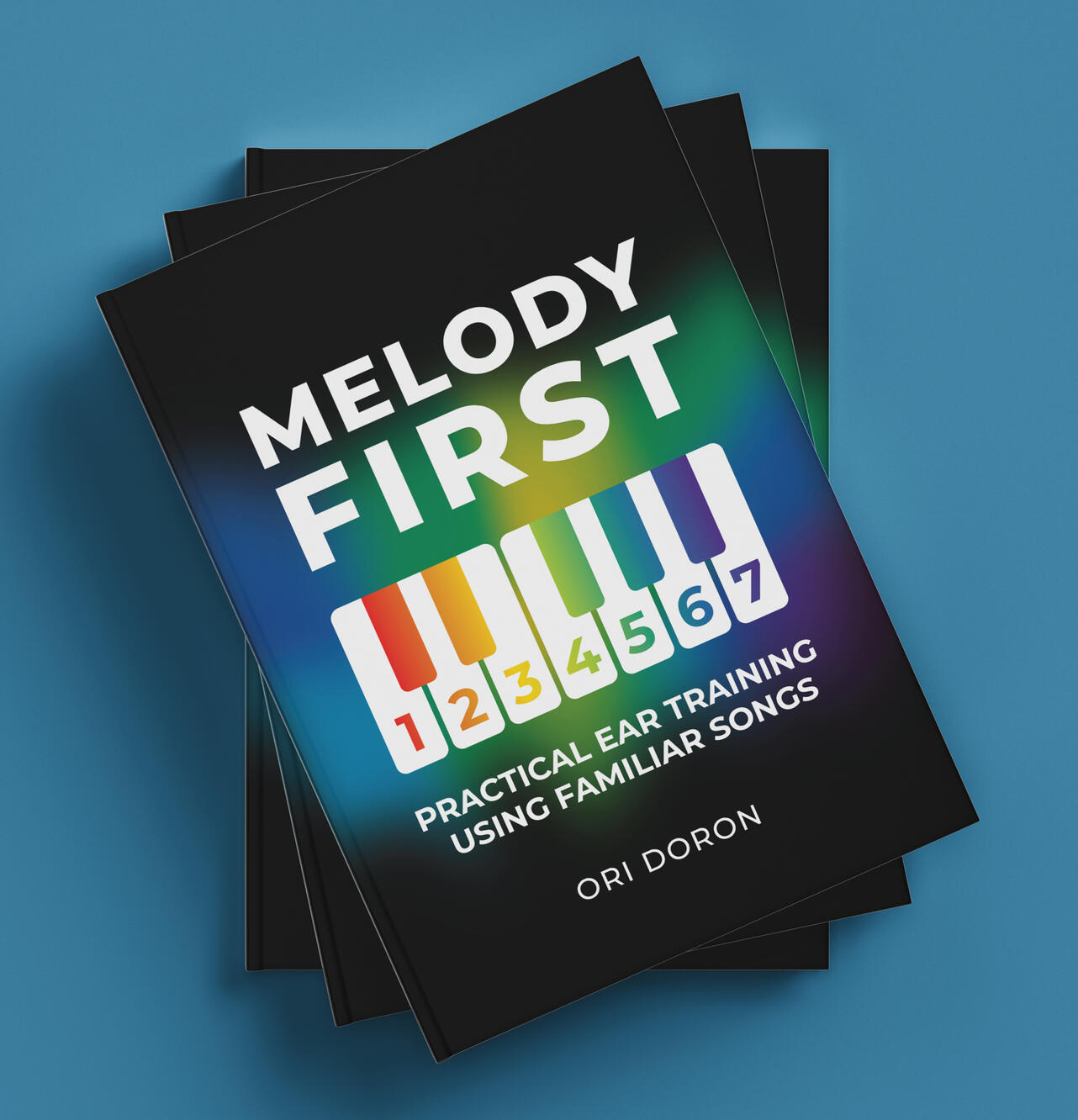
Chose between the premium physical workbook—featuring a vibrant color cover and a high-quality B&W interior designed for focused, distraction-free practice - or the Kindle Edition for learning on the go.
Sing The Scale Up and Down
Video Demonstration
Playing Songs with Numbers
Video Demonstration
Curious how it works in action?Get an exclusive video walkthrough
and materials sent straight to your inbox.
Contact Us